The beauty of Borobudur, this is the story behind its beauty
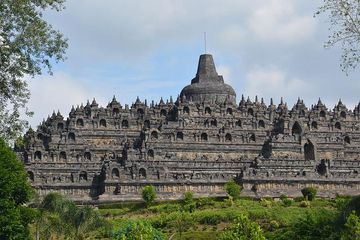
Borobudur Temple has a long history. This site is a testament to the historical development of Buddhism in Indonesia. Based on information from the heritage of the Ministry of Education and Culture, Borobudur Temple is said to have been established during the reign of the Shailendra dynasty from 750 to 842 AD. Its establishment is expected to be gradual and mutually cooperative as a form of worship of Buddhist teachings. The Borobudur Conservation Center, on its website, historian J.G. de Casparis, claims that the founder of the Borobudur temple was King Samaratunga, who reigned from 782 CE to 812 CE in the Syailendra dynasty. I'm here. Borobudur Temple was built to honor Mahayana Buddhism. This opinion is based on interpretations of the inscription of AD 824 and the Sri Kafulnan inscription of AD 842.
The Ministry of Heritage, Education and Culture explains on its website that there is another interpretation that the Borobudur temple has more than just a Buddhist background. Temple architecture is also characterized by the concept of ancestor worship, which manifests itself in the form of terraced architecture. Therefore, Borobudur Temple has multiple functions: a memorial to honor the ancestors of the founder of the Shailendra dynasty and a memorial to honor Buddhism.
Discovering Borobudur Borobudur Temple is located in Borobudur Village, Borobudur District, Magelang Regency, Central Java. Abandoned historic site. Some experts suspect that the 1006 eruption of Mount Merapi was the reason the temple complex was abandoned. However, geological, volcanological and archaeological studies have not been able to prove this great eruption. In the 18th century, Borobudur Temple certainly fell out of use. Some Javanese manuscripts, including the Centini, mention the location of this temple as being on a hill or a place that could bring death or misfortune. means See Buddhist photos in moments of Tri Suci Vesak 2566 BE in the courtyard of Borobudur Temple.
Borobudur Temple was rediscovered in 1814. The Borobudur Conservation Center says on its website that the British Governor-General, Sir Thomas Stamford Raffles, has received information that stone structures have been discovered in the Kedu area. Raffles then sent a Dutchman named Cornelius to lead a cleanup of the place, which was then covered with dirt, shrubs and trees. In 1835 the cleansing was continued by Kedu resident Hartman. Not only did he clean up, but he also did an on-site survey. However, no report of this study has been published so far.
This procession welcomes the Tri Suci Vesak Celebration 2556 BE. The celebration marks Gautama Buddha's three important events: his birth, fulfillment and death. Kompas/P Raditya Mahendra Yasa (WEN) May 26, 2012 (PRADITYA MAHENDRA YASA) Restoration of Borobudur Two major restorations of Borobudur Temple have been documented based on information from the Borobudur Conservation Centre. The first restoration was carried out by the Dutch East Indies government led by Van Erp and the second by the Indonesian government chaired by Sukumono. The first restoration, carried out from 1907 to his 1911, was entirely carried out by the Dutch East Indies Government under the direction of Van Erp. The Dutch East Indies government agreed to pay his 48,000 guilders for the restoration of the temple. The object of restoration was mainly the top of the temple, that is, he three circular terraces and the stupa.
A second restoration was carried out by the Indonesian government in 1973-1983 under the direction of Sukumono. In 1955, based on information from the Heritage of the Ministry of Education and Culture, the Indonesian government submitted an application to UNESCO to assist in resolving the Borobudur temple issue. UNESCO has called an expert, namely Professor Dr. P. Coremans, Director of the Central Research Institute of the Museum of Fine Arts of Belgium. Coremans diagnosed that the Borobudur temple was suffering from "stone cancer", which, if left unattended, would slowly destroy the stones of the temple.
UNESCO has also become actively involved in these conservation efforts. In 1971, a major attempt was made to preserve Borobudur Temple after UNESCO approved a grant to be awarded for the restoration of the temple. On February 23, 1983, the restoration of Borobudur Temple was declared complete. Additionally, President Suharto dedicated the opening of Borobudur Temple to the wider community. In 1991, Borobudur Temple was listed as a UNESCO World Heritage Site along with Pawon Temple and Mendut Temple. UNESCO has named this place Borobudur Temple Complex. In 2008, the Borobudur temple area was designated as a National Strategic Area. This step is followed by a zoning review and reorientation.

Comments
Post a Comment