Learn the history of the national monument aka Monas
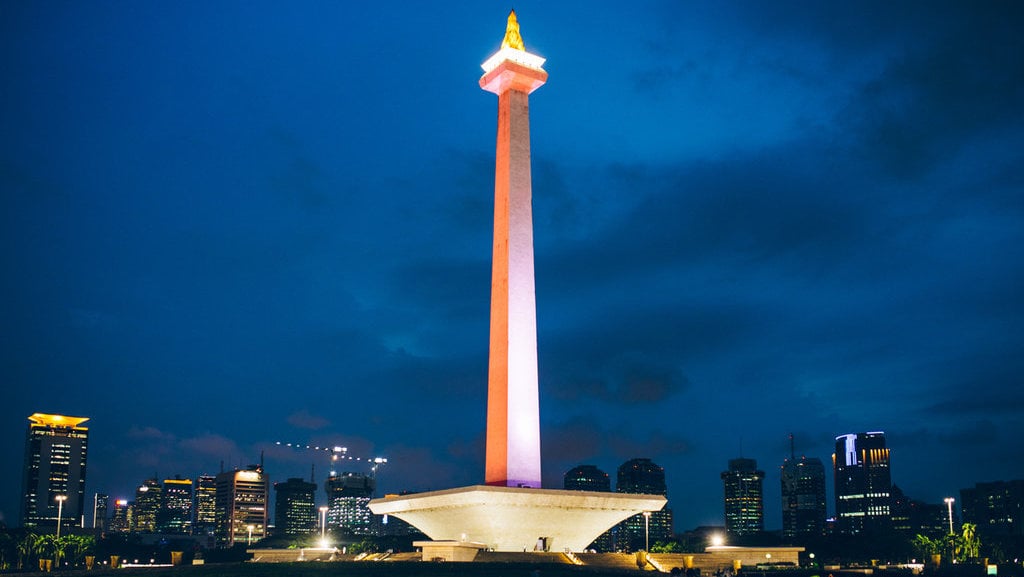
The National Monument, abbreviated as Monas or Tugu Monas, is a 132-meter (433-foot) tall monument located in the middle of Medan Merdeka Square in central Jakarta. Monas was established to commemorate the resistance and struggle of the Indonesian people to win independence from the colonial rule of the Dutch Empire. Construction began on August 17, 1961 by order of President Sukarno and was opened to the public on July 12, 1975. The monument is covered in flames covered with sheets of gold, symbolizing the fiery fighting spirit of the Indonesian people.
The monument and museum are open daily from 08:00 to 16:00 WIB (UTC+7), except Mondays when the monument is closed. Since April 2016, it is also open at night from 19:00 to 22:00 WIB (UTC+7) from Tuesday to Friday and from 19:00 to 00:00 WIB (UTC+7) on Saturday and Sunday.
Talk
The first ideas for creating national monuments came from ordinary people whose names were not mentioned nor written in inscriptions. My name is Salwoco Martocoesoemo. Jakarta's former mayor Sudiro (1953-1960), in an article published on page 3 of his daily newspaper Compass on Wednesday, August 18, 1971, stated that the first idea to establish Monas was that the president, minister, or I stressed very much that it did not come from the party leader. Not even mayor or mayor member of DPR(D). “The first person to come up with this idea was Salwoko Martokoesoemo, an ordinary Indonesian, private and humble city resident from Jakarta,” Sudiro said. Formerly based in Yogyakarta after the unitary sovereignty of the Republic of Indonesia was recognized in 1950 by the colonial government of the Dutch Empire and the return of the central government of the Republic of Indonesia to Jakarta in 1949. I left it. He plans to build a national monument dedicated to the Eiffel Tower on the square directly in front of the Independence Palace. The construction of the Monas Monument aims to commemorate and preserve the struggle of the Indonesian people during the 1945 independence revolution to inspire and continue to inspire future generations of national patriotism.
A national committee was formed on August 17, 1954, and a national monument design competition was held in 1955. Of the 51 works submitted, only one, by Friedrich Silavan, met the criteria set by the commission. A second competition was held in 1960, but none of the 136 participants met the criteria. The chairman of the jury then asked Siraban to show his design to Sukarno. However, Sukarno didn't like the design and wanted the monument to be in the shape of a phallus and a yoni. Silavan was then commissioned to design a monument with such a theme, but the design proposed by Silavan was too eccentric, so the cost was very high, especially since the economic situation was very bad at the time, and the state budget Couldn't afford it. Silavan rejected the design of a smaller building and suggested delaying construction until the Indonesian economy recovered. Sukarno then asked the architect Sudarsono to continue the design. Sudarsono inserted the numbers 17, 8 and 45 into the design of the monument, which symbolizes the beginning of the Indonesian Declaration of Independence on August 17, 1945. Later this national monument he built on an area of 80 hectares. The monument was designed by Friedrich Silaban and Sudarsono and erected on August 17, 1961.
Development period
Development consists of three stages. The first phase, from his 1961/1962 to his 1964/1965 period, officially began construction on 17 August 1961, when Sukarno ceremoniously installed the first concrete pillars. It started with A total of 284 concrete columns were used as the foundation of the building. A total of 360 soil pilings were planted to establish the National History Museum. The entire foundation work was completed in March 1962. The museum walls at the foot of the building were completed in October. After that, construction of the obelisk began and was completed in August 1963. Construction of the second phase occurred from He 1966 to He 1968 due to the 30 September movement, so this phase was delayed. The final phase took place from 1969 to 1976 with the addition of dioramas to the Historical Museum. Construction is complete, but problems still occur, such as water leaks that flooded the museum. The monument was officially unveiled and inaugurated on July 12, 1975 by President Suharto of the Republic of Indonesia. The place where this monument was built is known as Medan Merdeka. Monas Square has been renamed into five names: Gambir Field, Raft Field, Merdeka Square, Monas Square and Monas Park. Around the monument are gardens, two ponds and several open fields for exercise. Medan Merdeka on public holidays is full of visitors enjoying the view of the Monas Monument and doing various activities in the park.
plan to build a monument
The design of the Monas Monument is based on the concept of the eternal and universal couple. Phallus and Yoni. The towering obelisk is the male phallus, the active and positive masculine element, symbolizing the sunlight. The courtyard of the obelisk's base shell is the yoni, symbolizing the feminine, the passive and negative feminine element, and the night. The lingam and yoni are symbols of fertility and harmonious unity, and have complemented each other since prehistoric times in Indonesia. Additionally, the shape of the Tugu Monas can also be interpreted as a pair of 'pestle' and 'lesung' found in traditional Indonesian farmer households. As such, Monas' designs are full of distinctive aspects of Indonesian culture. The monument consists of a 117.7-meter-high obelisk at the Kerchhof, a 17-meter-high square base. The monument is lined with Italian marble.
His 25 x 25 meter pool at Medan Mrudekautara Park was designed as part of the air conditioning and aims to enhance the appearance of Monas his park. Nearby is a fountain and a bronze statue of Prince Diponegoro riding an 8-ton horse. The statue was sculpted by Italian sculptor Professor Covellato [7] as a donation from Honorary Consul General Dr. Dennis. Mario from Indonesia. The entrance to Monas is in Medan He Murdekautala Park near the statue of Prince Diponegoro. The entrance is through a tunnel three meters below him in the park, and this is the Monas Crossing, the visitor's entrance to the Monas Monument. The ticket office is at the end of the tunnel. Back on the ground north of Monas, visitors can continue to see reliefs of Indonesia's struggle history. Enter the National History Museum through the door in the northeast corner, go straight to the central solitary chamber, or take the elevator to the top courtyard of the monument.
Indonesian history relief
At each corner of the courtyard surrounding the monument is a relief depicting Indonesian history. This relief begins in the northeast corner and perpetuates the archipelago's past splendor. The story of Sinhasari and Majapahit. This relief continues chronologically clockwise to the southeast, southwest, and northwest corners.
A chronological account of the Dutch colonial era, the resistance of the Indonesian people and national heroes of Indonesia, the formation of modern organizations, the independence of Indonesia in the first half of the 1920s, the subsequent revolution and independence war of the Republic of Indonesia, and the development of modern Indonesia. era. The reliefs and statues are made of cement with tubular or metal frames, although some of the statues and statues appear to have been damaged by rain or tropical weather. National History Museum
At the foot of the monument, which is 3 meters deep, is the Indonesian National History Museum. The large room of the National Struggle History Museum with an area of 80 x 80 meters can accommodate about 500 visitors. This large marble-clad room has 48 dioramas on all four sides and three of his in the center, for a total of 51 dioramas. This diorama shows the history of Indonesia from prehistory to the New Order era. This diorama begins in the northeast corner and follows the history of Indonesia clockwise. Beginning in prehistoric times, followed by ancient empires like the Srivijaya and Majapahit, followed by European colonialism, and the resistance of pre-independence national heroes against the VOC and the Dutch East Indies government. The diorama continued from the Indonesian National Movement period, the Japanese Occupation period, the War of Independence, the Revolutionary period in the early 20th century to the New Order period in the Suharto era.
independent room
Inside the commemorative cup is an amphitheater-shaped stand-alone room. This room is accessed by a spiral staircase from north and south doors. This space contains the national and independence symbols of the Republic of Indonesia. Among them are the original Indonesian Declaration of Independence, which is kept in a glass box inside the golden gate, the national symbol of Indonesia, and a map of the archipelago of the unified state of the Republic of Indonesia plated in gold and red. A wall engraved with a white flag and the text of the Declaration of Independence of the Republic of Indonesia.
In the Independence Room, a national monument is used as a tranquil place for moments of tranquility and meditation to commemorate the nature of independence and the struggle of the Indonesian people. The original Indonesian Declaration of Independence is kept in a display case inside the golden gate. This mechanical door weighs 4 tons in gold-plated bronze and is decorated with carvings of the Wijaya Kusuma flower, symbolizing immortality, and the lotus flower, symbolizing purity. This door is located in the western wall, exactly in the middle of the room, and is covered with black marble. This door, known as the Gate of Independence, opens mechanically while the song "Padam Negri" is played, followed by Sukarno reading the text of his decree of August 17, 1945. It's been recorded.
On the south side is Garuda Pancasila, the national symbol of Indonesia, made of 3.5 tons of gold-plated bronze. On the east side there is a proclamation inscription in bronze letters, this side was intended to show the most sacred and glorious banner of Sang Saka Merah Putih, first raised on 17 August 1945. Fragile, this sacred flag is not shown. To the north of this black marble wall is a golden archipelago of archipelagos symbolizing the united state position of the Republic of Indonesia.
Peak Court and the Flame of Independence
An elevator (lift) at the south door takes visitors to her 11 x 11 meters and 115 meters above ground level courtyard at the top. This elevator can accommodate 11 of her people at once. The summit courtyard seats about 50 people and has binoculars for up-close panoramas of Jakarta. There is a steel emergency staircase around the elevator body. From the top courtyard of Monas Monument, visitors can enjoy views of every corner of Jakarta. In clear, smog-free weather, Mount Salak in the Bogor district of West Java can be seen in the distance to the south, and the open sea with small islands spreads out to the north.
At the top of the national monument is a 14.5-tonne, 35-kilogram gold-plated bronze cup that supports the flame of his lamp. This flame or torch is 14 meters high and 6 meters in diameter and consists of his 77 parts connected together. This tongue of fire is a symbol of Indonesians' fighting spirit for independence. Initially, this bronze flame was coated with a 35kg gold plate, but to commemorate the half century (50th anniversary) of Indonesia's independence in 1995, this gold plate was re-coated and a 50kg gold plate weight was applied. It's been a long time. The top of the monument is in the shape of an "unquenchable fire", which means that the Indonesian people have a burning fighting spirit, never let their guard down and do not put out the fire. Pokarhof offers visitors a view from a height of 17 meters above the ground. The Court of the Cup can be reached by taking the elevator down from the top platform or by taking the stairs that reach the bottom of the cup. The height from the bottom of the cup to the plate is 17 meters, and the height from the room in the history museum to the bottom of the cup is 8 meters (3 meters underground + 5 meters of stairs to the bottom of the cup). ). His 45 x 45 meter square area in the courtyard is part of the preservation of sacred figures from the Declaration of Independence of the Republic of Indonesia (17 August 1945). A total of 28kg of the 38kg of gold in the Monas Torch was donated by Aceh businessman Teuk Malcum, once one of Indonesia's richest people.

Comments
Post a Comment